


About the Series: In this 6-week series, I will review and analyze films specially curated for the theme “Women on the Verge (Of a Nervous Breakdown).” Enjoy analyses and thoughts on our cinematic favorites, underrated gems, and discover what makes the featured women protagonists “On the Verge.”
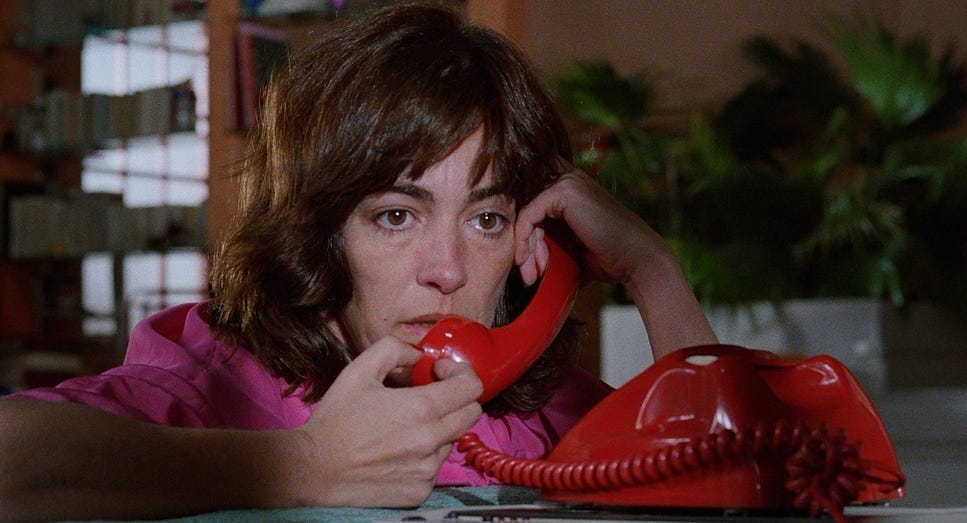
The time has come to wrap this series. What better way than the namesake? Directed by the iconic Pedro Almodóvar, Mujeres al borde de un ataque de nervios, or Women on the Verge of a Nervous Breakdown, is a timeless dramedy about desperation, guilt, shame, lost love, and a dash of paranoia, all blended into a tomato-flavored gazpacho soup. Almodóvar creates a peculiar world where audiences laugh, smile, frown, and have no moment to pause before the next character enters with a crisis or a wrench to throw. Using its campy exteriors to its advantage, it maintains its seriousness, knowing that, while silly, these behaviors are rooted in truth. Guided by the incomparable Carmen Maura as Pepa, the film shows how women are pushed to the edge of psychological collapse not because they are inherently unstable, but because they are expected to quietly absorb betrayal, abandonment, fear, and impossible emotional burdens.
Voice-over artist Pepa has recently been left by her lover, Ivan (Fernando Guillén). Stomaching the weight of this breakup and knowing that she is carrying his unborn child, she begins a desperate plea to reach him. As a sinister game of phone tag ensues, Pepa teeters on the verge of her Breakdown (ataque de nervios) by unintentionally setting the bed on fire, watching it burn, putting her apartment up for rent, and spiking an entire pitcher of gazpacho with barbiturates as a trap for her ex-lover Ivan.
It is usually expected of women to be visually more distraught than men while grieving a relationship. Women are permitted a week, maybe two tops, to be upset. After that, it is expected that one must be strong and to “not let him see you sweat.” Pepa lives in this moment. She spirals, she talks about him every chance she gets, and is desperately seeking answers to her questions. She rejects the expectation that grief should be tidy, private, and temporary. Silent strength is out the window; just like her telephone, ripped from the wall and chucked over the balcony.

Then there is Candela (María Barranco), Pepa’s friend who lives in a constant state of ataque de nervios. After learning that her lover is actually a terrorist who has been recently detained, she is paranoid about being arrested for her non-willful involvement. Through her state of panic, she attempts to take her own life by jumping from Pepa’s terrace. Despite her character’s introduction, all ends well for Candela. She finds a new boyfriend, and fingers crossed he is not a terrorist like the last one.
And maybe that depends on one’s definition of terrorist. Because Candela’s new boyfriend, Carlos (Antonio Banderas), is introduced earlier in the film in conjunction with Marcia (Rossy de Palma) as her fiancée. Carlos and Marcia knock on Pepa’s door as inquiring renters of her recently listed apartment. After quickly discovering that Carlos is Ivan’s estranged son, Pepa and Carlos engage in an extended dialogue. Bored and not receiving attention from her lover, Marcia wanders away and drinks a hearty portion of the spiked gazpacho from Pepa’s fridge. Marcia falls asleep for several hours. It is then revealed that Carlos may be just like his father. Insecure and shallow. Though he is caring towards Pepa and Candela, he backstabs his fiancée Marcia by repeatedly kissing Candela and ending the film as Candela’s boyfriend, even though Marcia is still asleep in the house. Carlos appears different from Ivan but ultimately reproduces the same emotional selfishness. So, I repeat, it depends on one’s definition of “terrorist” to conclude if Candela’s ending is happy after all.
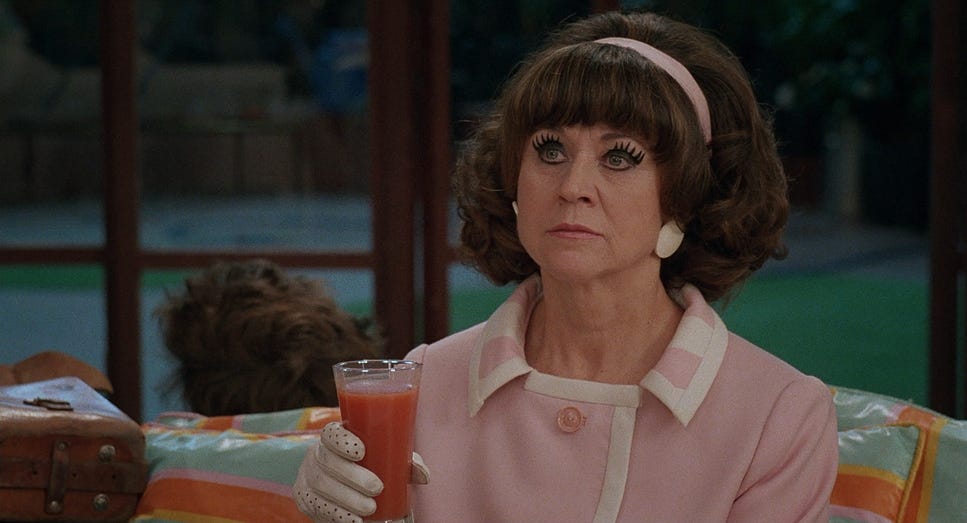
Next, we meet Lucia (Julieta Serrano). Lucia is Carlos’ mother and Ivan’s ex-wife. Lucia is the embodiment of campy with her exaggerated makeup and hairstyling and a pink checkered outfit that screams whimsical, childlike, and innocent when she could not be further from those descriptions. While pregnant with Carlos, Ivan left her for another woman. Shortly after giving birth, Lucia snaps and is sent to a mental facility, where she remains for the entirety of Carlos’ life. Recently, she heard Ivan’s voice on the television, faked being cured of her illness to get out, and made arrangements to see Ivan again. She crosses paths with Pepa, and after pulling a gun and a brief car chase, Lucia attempts to take Ivan’s life. She is stopped by Pepa, who at this point has come to terms with her desperation and has ceased her ataque de nervios. Lucia is not Pepa’s opposite. She is Pepa twenty years later, had Pepa never been allowed to let go.
Each woman featured in this film has a reason to spiral because of a man in their orbit. Ivan abandons both Pepa and Lucia while pregnant and ends the film as an attempted murder survivor at the hands of his “crazy and hospital-ridden” ex-wife. Truthfully, if Pepa was able to reach him, the spiked gazpacho would be his cause of death. Ivan leaves behind a trail of grieving and pregnant women and faces zero consequences. Candela was scorned by her terrorist ex-boyfriend; Marcia was scorned by Carlos, who dares to start a new relationship while Marcia is in the same room! Maybe these women would have a chance to regulate their nervous systems if the threat of becoming a scorned woman at the hands of lies and irresponsibility were removed. The protagonists do not create the emotional catastrophe they inhabit; they merely inherit its consequences.

Why would I pick this film to be the namesake for my Women on the Verge series? As women, we are forced to endure. While we slip into insanity, desperation, despair, and need to sit with these emotions in order to self-regulate, we are not afforded that privilege. We are forced to plaster on a smile because of external factors. Save face or risk punishment. Maintain employment to avoid abuse at home. Keep a sense of self-worth or face demise. We are vulnerable to being stripped back into the Breakdown by an elusive lover, a bounced check, even a minor inconvenience. As a woman, my goal in this series is to shed light on the reality that plagues us across cultures and time periods. We are tired of living on the verge, in the gray space between sane and insane. Scream, shout, cry, then return to form.
Women on the Verge of a Nervous Breakdown uses intentional language. The women are on the VERGE. There is an unwritten rule that the massive breaking of the psyche is imminent for all the women involved. While showing them slipping into the depths of insanity, Almodóvar refuses to define them by their worst emotional moment. In a world of madness and turmoil, be like Almodóvar. Step in and humanize your fellow woman, because that is how we move forward as a holistic society.
Thank you for reading my Women on the Verge (Of a Nervous Breakdown) series. This is the conclusion of the first curated series I have written on Substack. Please read the other films I analyzed under this thesis below. Stay tuned and subscribe, as I will be starting my second series next week. Have a great weekend, everyone, and a happy holiday!
A Girl Walks Home Alone at Night (2014) | Series 1: Women on the Verge (Of A Nervous Breakdown)

About the Series: In this 7-week series, I will review and analyze films specially curated for the theme “Women on the Verge (Of A Nervous Breakdown).” Enjoy analyses and thoughts on our cinematic favorites, underrated gems, and discover what makes the featured women protagonists, “On the Verge.”
Perfect Blue (1997) | Series 1: Women on the Verge (Of a Nervous Breakdown)

About the Series: In this 7-week series, I will review and analyze films specially curated for the theme “Women on the Verge (Of a Nervous Breakdown).” Enjoy analyses and thoughts on our cinematic favorites, underrated gems, and discover what makes the featured women protagonists, “On the Verge.”
Jennifer's Body (2009) | Series 1: Women on the Verge (Of a Nervous Breakdown)

About the Series: In this 7-week series, I will review and analyze films specially curated for the theme “Women on the Verge (Of a Nervous Breakdown).” Enjoy analyses and thoughts on our cinematic favorites, underrated gems, and discover what makes the featured women protagonists, “On the Verge.”
Ganja & Hess (1973) | Series 1: Women on the Verge (Of a Nervous Breakdown)

About the Series: In this 7-week series, I will review and analyze films specially curated for the theme “Women on the Verge (Of a Nervous Breakdown).” Enjoy analyses and thoughts on our cinematic favorites, underrated gems, and discover what makes the featured women protagonists, “On the Verge.”
Valley of the Dolls (1967) | Series 1: Women on the Verge (Of a Nervous Breakdown)

About the Series: In this 7-week series, I will review and analyze films specially curated for the theme “Women on the Verge (Of a Nervous Breakdown).” Enjoy analyses and thoughts on our cinematic favorites, underrated gems, and discover what makes the featured women protagonists, “On the Verge.”