


About the Series: In this 7-week series, I will review and analyze films specially curated for the theme “Women on the Verge (Of a Nervous Breakdown).” Enjoy analyses and thoughts on our cinematic favorites, underrated gems, and discover what makes the featured women protagonists, “On the Verge.”

In this haunting arthouse horror film written and directed by Bill Gunn, Ganja & Hess stands as a crucial sociological marker for the study of African American thought and life during the cutting edge of the Blaxploitation era. Starring Marlene Clark as Ganja Meda, Duanje Jones as Dr. Hess Green, and Bill Gunn as George Meda, the film explores religion, sensuality, and identity. Ganja, one of our titular characters, is often described in analyses of this film as a beautiful Black woman whose portrayal was uncommon for women during this time. Marlene Clark’s role as Ganja is iconic, unique, and progressive.
The film follows Dr. Hess Green, a wealthy archaeologist and historian studying the Myrthian tribe, an ancient African civilization wiped out by a mysterious blood disease 10,000 years before the Egyptians arrived. He invites his research assistant, George Meda, to his large estate in Westchester County, New York. There, Hess quickly encounters Meda’s unhinged mental state. Hess finds Meda sitting in a tree next to a noose, and later, Meda attempts to murder Hess with a Myrthian dagger. Meda then shoots himself in the heart and collapses to the floor. Hess should have died from Meda’s attack, but instead awakens with a Vampiric thirst for blood.
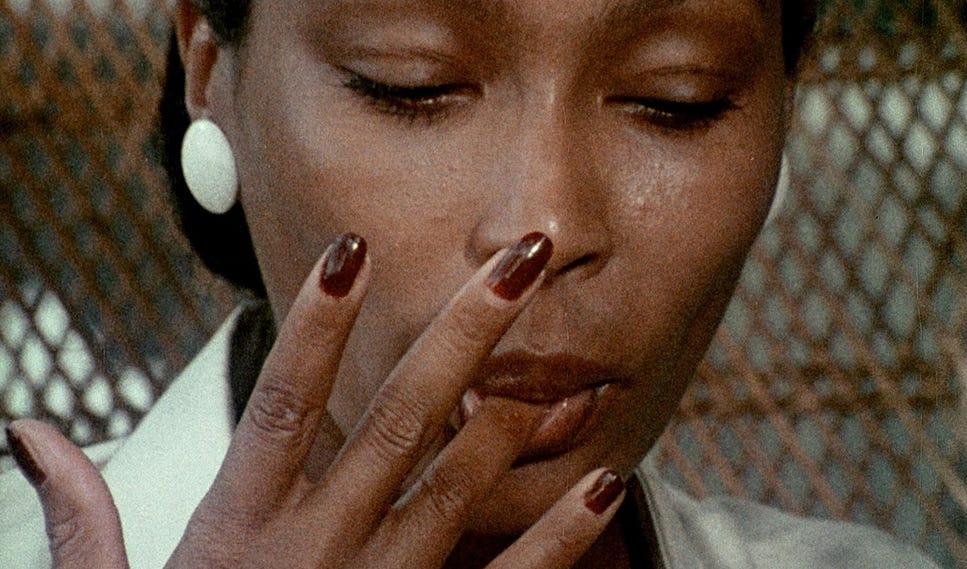
Not too long after these acts, Meda’s wife, Ganja, arrives at Hess’ estate looking for her husband. Ganja, though originally a bit brash, quickly falls for Hess; they marry, and in a sensual moment, Hess makes Ganja immortal like him. As the film progresses, Hess grows tired of the Vampire lifestyle while Ganja acclimates, making at least one kill, and several implied, during the film’s 111-minute runtime. Hess resolves to end his life, while Ganja retains agency of her existence and decides not to follow him into the afterlife. She carries on as a Myrthian vampire.
While pondering the role of Ganja, it is notable that her framing is of an independent woman. Blunt and standoffish. These are clear examples of traits often seen in women portrayed during the Blaxploitation era. Often depicted as superhuman-like figures with a harsh attitude, making it difficult for the average movie-goer to relate, this is expected of women protagonists. Ganja is an interesting case study when we think about “Women on the Verge of a Nervous Breakdown,” which is defined by the women who push themselves out of the box of societal expectations in film, and how these characters go about executing these actions.
Ganja stepped into the scene on the Verge. Not having to blatantly push herself out of the box, as she never allowed herself inside, she is strictly opposed to subservience. Ganja prefers to live in a world without decorum to get what she wants. Ganja’s character, though short-lived in the story, is a major focal point for critics and film fans for her refreshing and rich character development. She is not just a pretty decoration on the shelf. She is an individual successfully woven into the narrative who has wants, dreams, and disappointments. While the audience’s first impression of Ganja is to see her as spoiled and uninterested, her revealing backstory details the truth that her mother never loved her. Ganja refers to herself as a disease, stating that she always had to look after herself, while loathing her beauty.

Hess dies, and Ganja is left to her own devices. She is alone, not lonely, in control of her future and life. Her decision to allow Hess to leave Earth while she chose to stay indicates that Ganja has triumphed over the typical tropes women often fall into: hyper-sexualization, the aloof victim, and/or the annoying wife, never letting her husband alone. Ganja is “whole” and smiles softly to herself, ready to roam for all eternity. Manthia Diawara and Phyllis R. Klotman write, “Ganja is a contemporary black woman. She is tired of being subservient to the church and to black men. She’s glad that Meda and Hess, the self-destructive artist and the bourgeois patriarch, are gone.”
Ganja & Hess is notable for not framing African Americans exclusively through the lens of slavery. While it is a horror film, it was never shackled by a specific genre. Bill Gunn leaned into experimental arthouse styles, extremely reminiscent of Jean Luc Godard, while creating his own unique Black Aesthetic. This film lives on in the societal lexicon as a reminder of its highly stylized nature and as a trailblazer for Black horror and conceptual films. Taking the Dracula framework and turning it into his own, Gunn pays little attention to classical narrative features such as plot, instead focusing on the energy of the film. It is dreamy and non-linear, often jumping from scenes in the present to the ancient Myrthian society, and back, the usual suspense that we know and love from traditional horror films is cut short. In the end, it is left to the viewer to decide what happens in the story and what to think. Ganja & Hess lives on as a certified classic horror film.
As people who LOVE the movie (Mujeres al borde de un ataque de nervios), Black cinema, and all things horror-- this hit so good. Looking forward to the rest of the series 🤓